
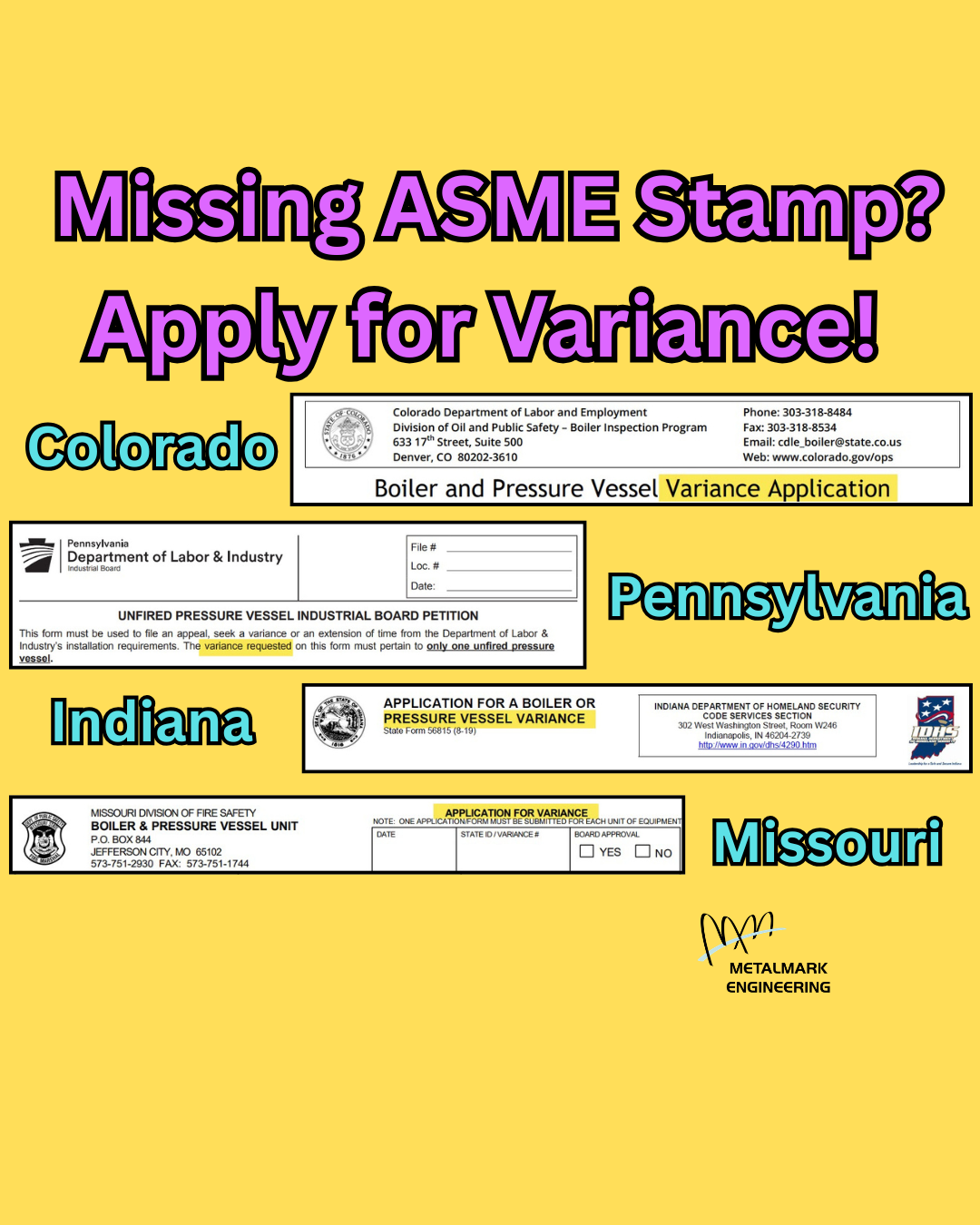
Use Variance Rules for Undocumented Equipment
Has a state regulator discovered your undocumented equipment yet? They will!
Your best bet is to have your variance application approved before you are forced to shut down.
Did you know some state regulators will not allow you to continue operation without an ASME Code Stamp on your pressure vessels and heat exchangers? That means you either have to purchase new equipment or apply for a variance. Even if you decide to purchase new equipment, a variance can help keep your facility running safely and legally until the new equipment can be installed. A big advantage over shutting down.

Re-Rates and De-Rates using Equivalent Hydrotest Stress
Why use Turnaround EPC, Inc. for your rerate or derate?
Speed in Proving Viability: We quickly determine if your pressure vessel or heat exchanger is a good candidate for a rerate*.
Calculation Accuracy: We are experienced in using the latest software tools to generate the ASME Code calculations required for rerates and derates.
Cost Savings: New pressure vessels and heat exchangers are expensive. Constructing a new vessel may not be necessary if another vessel can be rerated to meet your production needs.
Lead Time: Most new pressure vessels and heat exchangers take months to complete from design to installation. Rerated vessels may be used right away.
Process Experience: We are experienced in identifying API 571 damage mechanisms in process equipment and we understand the types of damage that may necessitate a derate.
Reasons for a pressure vessel or heat exchanger rerate:
Increased production: To increase output, it might be necessary to operate the vessel or heat exchanger at a higher pressure or temperature than the original Maximum Allowable Working Pressure (MAWP).
Process changes: Process evolution may require equipment to be reused in a new process, requiring a different Maximum Allowable Working Pressure (MAWP) for the pressure vessel or heat exchanger than the original design.
Corrosion consideration: Original design calculations may not have considered corrosion and process realities may require a rerate to adequately consider observed process corrosion.
Fitness-for-service assessment: An inspection might reveal that the vessel or heat exchanger has reduced integrity due to local damage, necessitating a reduction in the Maximum Allowable Working Pressure (MAWP).
*Metalmark Engineering PLLC does not consider rerates that require a hydrotest to be good candidates. Most rerates do not require a hydrotest.
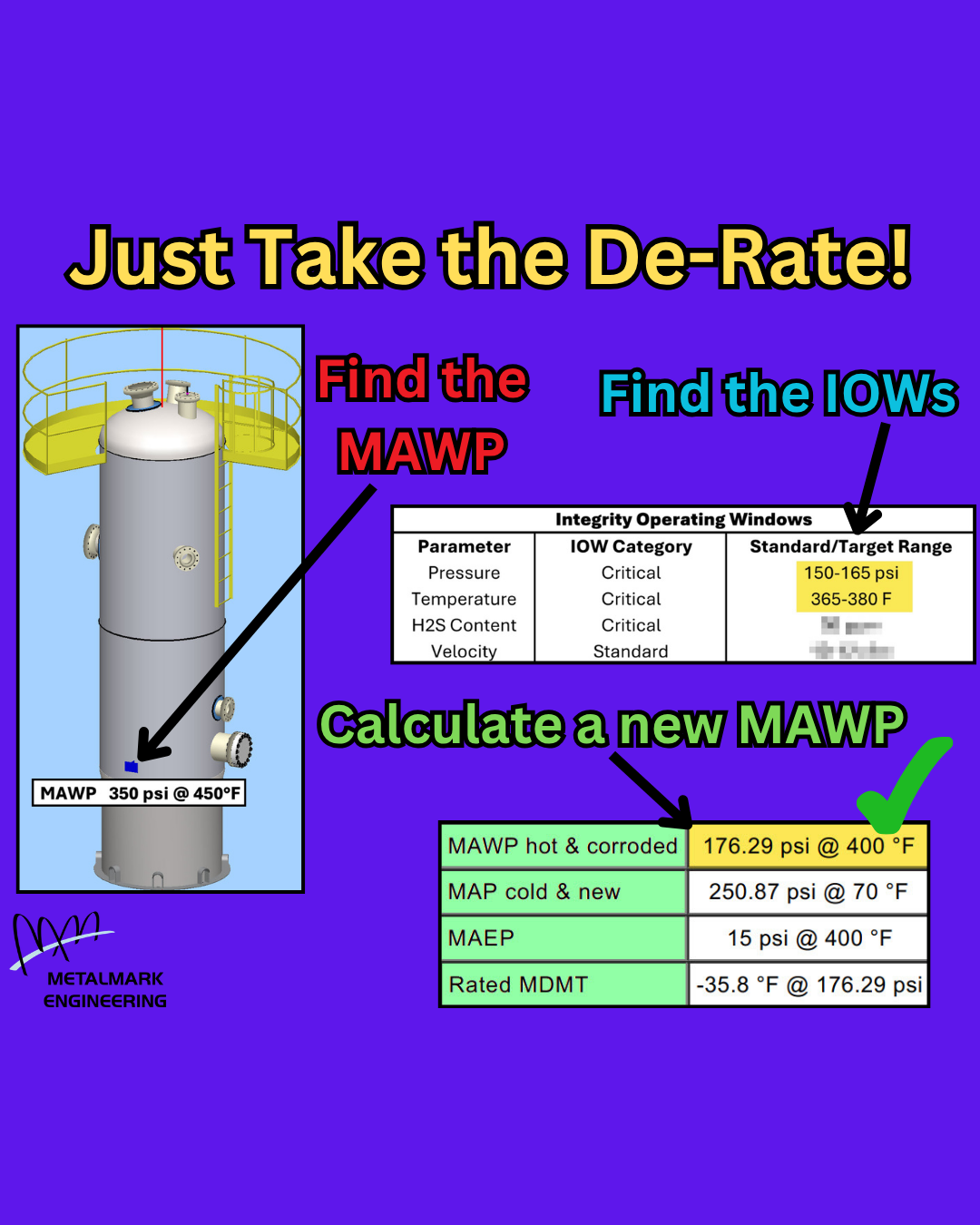
Just Take the Derate!
Fast. Safe. Effective…sometimes it’s easier to just take the De-rate and move on with your life.
I like the nice long inspection interval for internal inspections required per API 510. However, I’ve seen some pretty short inspection intervals for equipment trying to maintain original design pressures. If your original MAWP (Maximum Allowable Working Pressure) is much higher than your current operating pressure, JUST TAKE THE DE-RATE!
Fast - All you need is a set of drawings and your latest inspection reports with thickness readings. Turnaround can help you provide the inspection and thickness readings.
Safe - Reducing the MAWP of your equipment greatly reduces the risk of your facility because it ensures that the pressure on the original stamp is never attempted. Turnaround can provide complete pressure vessel and heat exchanger calculations to derate your equipment.
Effective - Reducing the MAWP of your equipment gets you back onto a normal inspection cycle. Turnaround EPC can help you plan your equipment inspection cycles to maximize uptime.

Undocumented Equipment
Missing your name plate? Even worse, are you missing your design calculations?
No documentation? No problem!
I’m often asked questions about undocumented equipment when I’m on site for turnarounds. Owner/Operators would like to return undocumented equipment back to service but they do not have an engineering department with enough time to handle the complexities involved. Material identification, measuring dimensions and thicknesses, performing internal and external inspections, and providing detailed calculations adds way too much workload to think about handling undocumented equipment internally.
So it sits…and sits...
Sure, not all undocumented equipment is suitable to return to service, but wouldn’t you like to find out?
Metalmark Engineering helps you stay on top of OSHA’s Process Safety Management (PSM) program by providing missing design calculations, inspection reports, and detailed design drawings for your equipment without documentation.
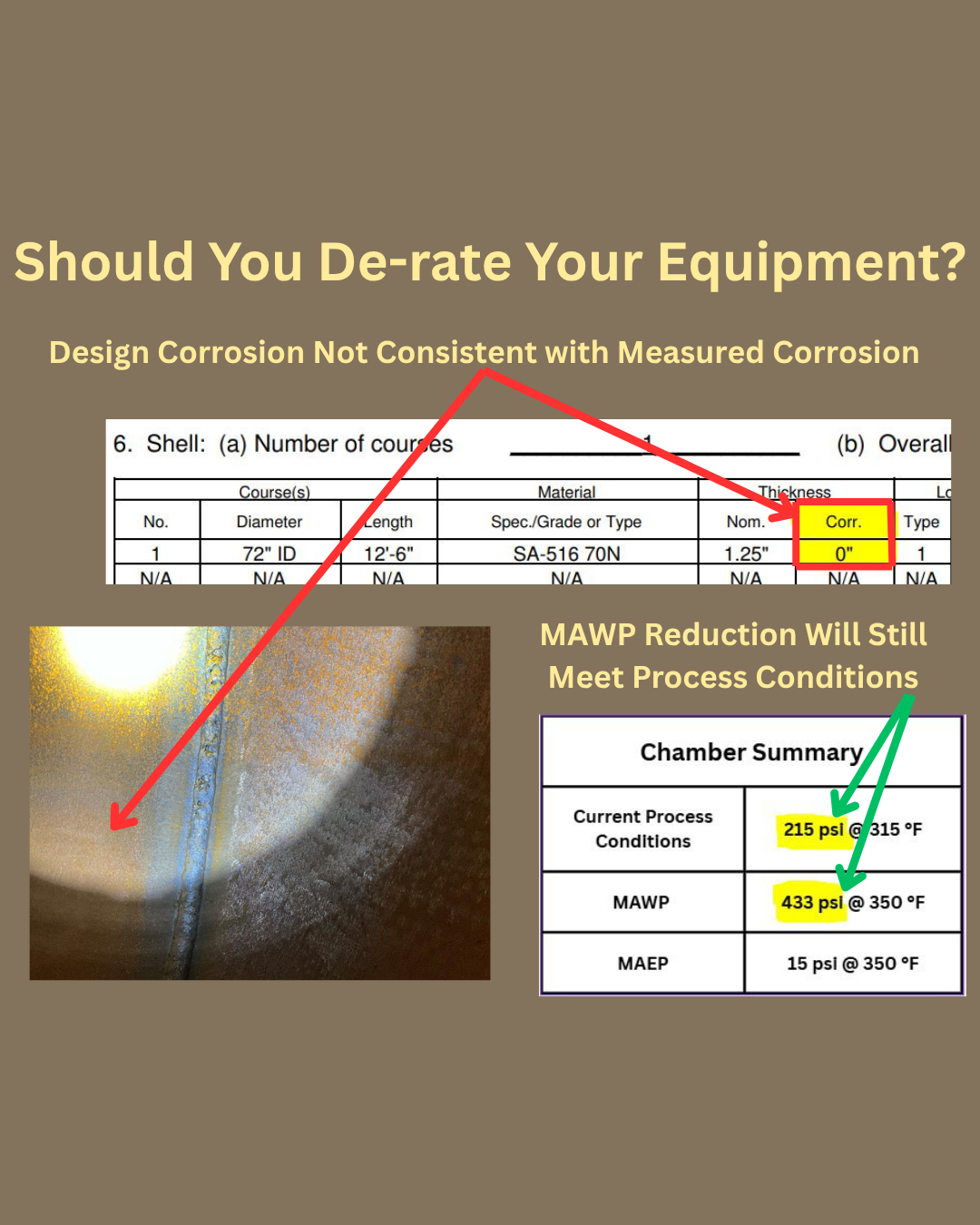
Derating for Process Safety Reasons
Why would anyone de-rate a pressure vessel or heat exchanger? What is the point of formally accepting less out of your equipment than it was designed for?
The simple answer is to reduce the operational risk at your facility by ensuring that pressurizing to the original Maximum Allowable Working Pressure (MAWP) is never attempted. The most common scenario I observe is when a design with no corrosion allowance does not align with measured in-service corrosion.
Many times pressure vessels and heat exchangers operate much lower than their ratings so de-rating causes no operational disruptions. Is there any equipment in your facility that could use a de-rate?

Location Matters for De-Rates During Turnarounds
Let’s talk about de-rating equipment during turnarounds. Not every jurisdiction allows it.
De-rating in-service equipment greatly lowers operational risk of a facility because it ensures unsafe pressures and temperatures for degraded equipment are no longer available per nameplate. In essence, it prevents C-Suite executives from trying to force any of their unsafe ideas onto unsuspecting operators without immediate pushback. I perform these “Safety De-Rates” as a tool in my turnaround toolbox for mechanical integrity programs in Texas and pretty much everywhere else.
…but not in California. Circular Letter PV-2001-1 makes it clear that de-rates for process safety reasons, or any other reason, during turnarounds are not allowed. I do not and will not perform any de-rates or re-rates in California even though the plethora of decommissioned equipment sitting around makes it tempting.
Thinking about de-rating your equipment for process safety reasons? Turnaround EPC specializes in de-rating heat exchangers and pressure vessels.