
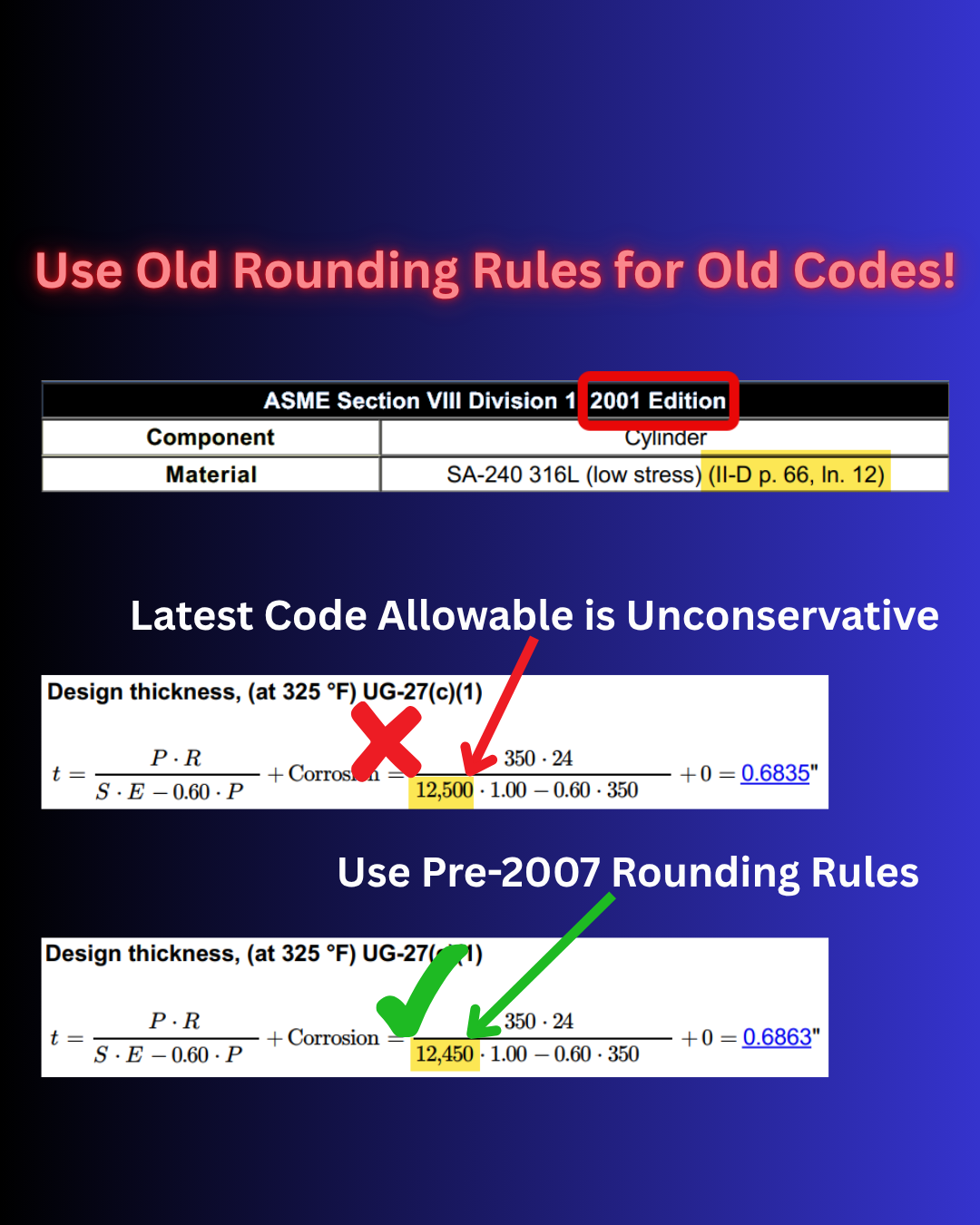
Allowable Stress Rounding Rules Changed in 2007
Did you know that the rounding rules for allowable stresses in ASME Section II-D changed in 2007?
If you are anything like me you have to run a lot of calculations on older equipment. Making sure I use the correct allowable stress is not always a straightforward task. One ASME Code change I have to remember is to the rounding rules in the 2007 version of ASME Section II-D.
In this example using the latest allowable stress rounding rules results in an unconservative required thickness because the original design was calculated using a lower allowable stress. Please do not accidentally give yourself credit for the newer allowable stress rounding rules when re-calculating older equipment.

Missing Floating Tubesheet Calculations
Does your floating tubesheet heat exchanger have complete calculations?
I have been asked many times to check calculations for floating tubesheet heat exchangers only to find some of them missing. The calculation I see most often omitted is from the shell side pressure acting on the internal floating tubesheet components. The external pressure from the shell side often governs over the internal pressure from the tube side so checking this case is critical.
Many Owner/Operators will accept equipment for service without these calculations performed. Please double-check this case in your floating tubesheet heat exchangers.

ASME PCC-1 Appendix O Joint Assembly
Proper flanged joint assemblies depend on the interaction of the flanges, gasket, and bolts. ASME PCC-1 Appendix O investigates the interaction of flange stresses, gasket stresses, and bolt stresses to determine proper bolt torque values.
Why use Metalmark Engineering for your ASME PCC-1 Appendix O assessment?
Maximum Permissible Bolt Stress for the Flange, Sfmax calculation. Metalmark Engineering uses a complete Appendix 2 flange assessment with WRC 538 to determine the Maximum Permissible Bolt Stress for the Flange needed for ASME PCC-1 Appendix O.
Target Assembly Gasket Stress, Sgt determination. Metalmark Engineering works with gasket manufacturers and does not rely on assumed default values for Target Assembly Gasket Stress, Maximum Permissible Gasket Stress, Maximum Operating Gasket Stress, and Maximum Seating Gasket Stress.
Assembly Bolt Stress. SBsel determination. Metalmark Engineering determines the Assembly Bolt Stress and assesses if the upper bolt limit controls, if the lower bolt limit controls, or if the flange limit controls before determining if gasket seating stress is achieved.