

Stop Using Class 1 Bolts
I’m still seeing too many low strength bolts in the field. Please check your bolts to make sure they are the high strength version.
It is difficult for engineers like me to fix bolted flange leaks caused by low strength bolts without first replacing the bolts with the high strength version. There can be a 70 ksi (480 MPa) yield strength difference between the two.
Why can’t the bolted flange assembly seal? Well the bolts yield before the Minimum Gasket Seating Stress, Sgmin-S is reached. This is especially common for the folks that are still using air impact wrenches to torque their bolts. Adding more bolt load, which is the first solution tried in the field, does not help because the bolts keep stretching as more load is applied.
I like to have enough bolt load to reach the Target Assembly Gasket Stress, SgT. This is almost always impossible with low strength bolts.

Track Flange History with ASME PCC-1 Appendix R
Do you track the history of the flange pairs in your facility? You should. A well documented history of each bolted flange assembly makes it easier to determine the source of new leaks.
A good flange history also helps prevent new leaks from occurring in the first place, especially during turnarounds. Sometimes it is as simple as not repeating the same mistakes as another assembler. Other times I need the flange history plus the calculation of the gasket, bolt, and flange stresses using PCC-1 Appendix O determine exactly what went wrong during prior assemblies.
As an engineer, I want as much information about the bolted flange assembly as I can get. I want to know everything about the gaskets, the bolts, the lubricant used, the target torque, the tool used, and everything else you can give me. This information helps me make a plan for each flange pair for the turnaround. Having the flange history in one convenient place makes sense.
Not tracking the flange pairs in your facility? Send me a message because your next turnaround is a great time to start.
Check out ASME PCC-1 Appendix R for more information regarding Assembly Records Management.
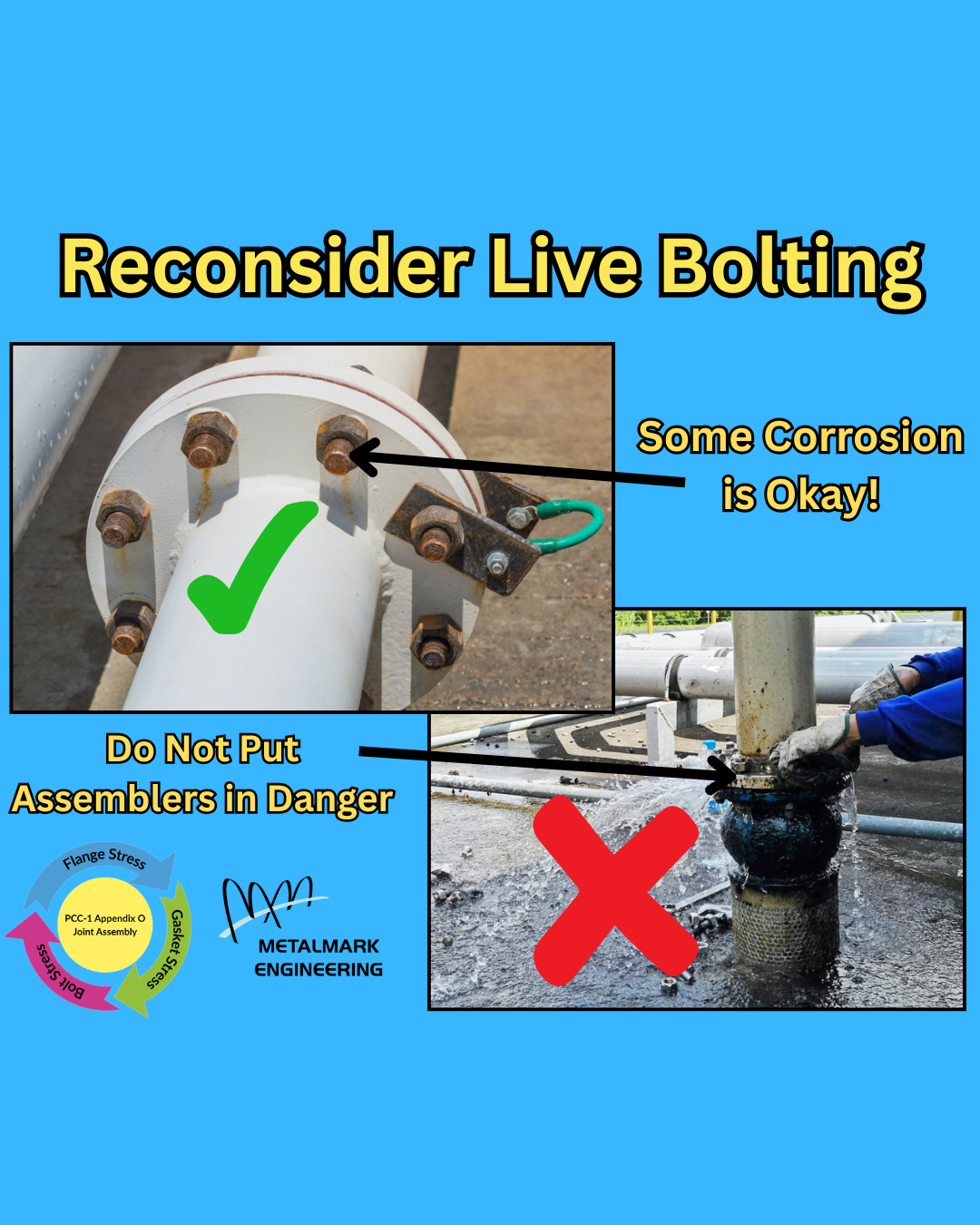
Reconsider Live/Hot Bolting
How frequently are you performing live bolting? It may be way too often.
Every once-in-a-while folks from corporate will put on PPE like a children’s halloween costume and walk the facility. For some reason they like to fixate on rusty bolts. Before you know it, they’ve convinced themselves that replacing the rusty bolts cannot wait until the next turnaround; they must be replaced as soon as possible with the live bolting technique.
Live bolting (or hot bolting) is the process of replacing bolts while the process is still active. This means replacing bolts at elevated temperatures and pressures that puts the assemblers at an elevated risk. Many times this risk is not worth the problem it is trying to solve.
Replacing bolts one-at-a-time requires the remaining bolts to keep the flange connection sealed. Sometimes it’s just not possible.
I do not recommend live bolting flanged connections that are limited by the Maximum Bolt Stress, Sbmax, because the gasket is already performing below the Target Assembly Gasket Stress, Sgt.

No Threaded Flanges in ASME Division 1 and Division 2 Vessels
I’m fine Replacing-In-Kind, but I’m not going to Replace-In-Kind the threaded flanges from your old pressure vessel and heat exchanger drawings. Spotting threaded flanges in your old drawings signals that it’s a great time for some upgrades.
I understand that it’s tough keeping up with updates to all of the codes and standards required. That’s why I represent Owner/Operators by helping them enforce their own specifications. Specifications without enforcement are just words on a page.
I don’t allow threaded flanges in facilities that use Process Industry Practices (PIP) standards because threaded flanges are not allowed in vessels designed per ASME Code Section VIII Division 1 and 2.
Joint Industry Project 33 (JIP 33) doesn’t allow threaded flanges either.

Finding ASME B16.5 Blind Flange Bolt Load
Having a difficult time figuring out the Bolt Load (W) for your modified ASME B16.5 blind flange? Check the flange it is attached to!
Oftentimes ASME B16.5 blind flanges used as reducers include pipes larger than allowed in B16.5 without a reinforcement calculation. I have found that the additional bolted cover calculation trips up some designers as they were expecting the ASME B16.5 blind flange to be exempt. The most common reason people reach out to me is for help finding the Bolt Load (W) needed in the bolted cover required thickness calculation.
Please remember that mating pairs share the Bolt Load (W). This means that finding the Bolt Load (W) needed for the bolted cover required thickness calculation may be as simple as grabbing it from the flange it is attached to.
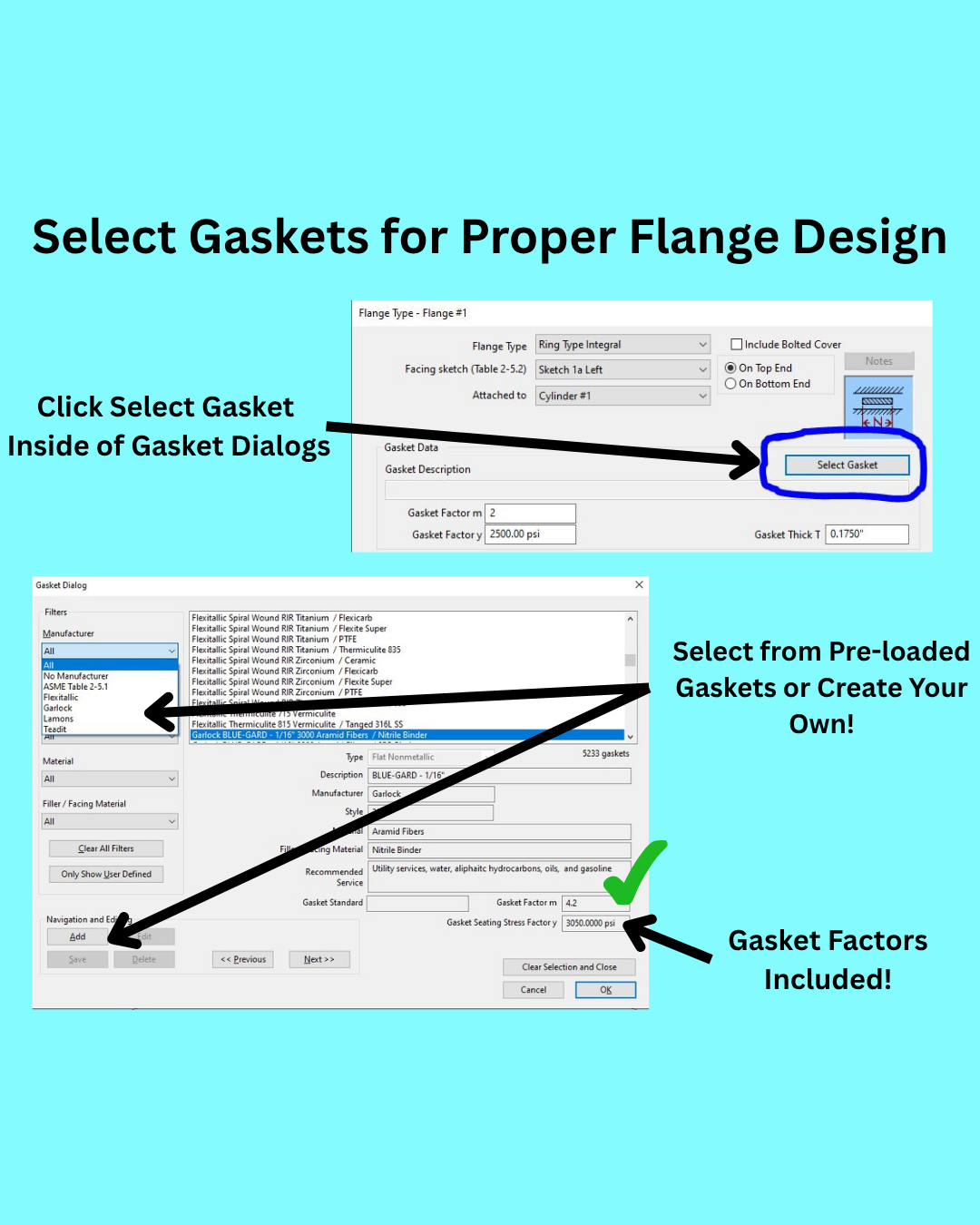
Simple Gasket Look-Up in COMPRESS
Do you spend too much time looking up Gasket Factor (m) and Gasket Seating Stress Factor (y) values?
Whenever someone asks me to design a custom Appendix 2 or Part 4.16 flange I want to know the m and y factors of the gaskets they intend to use. A lot of times this crucial gasket design information is tough to track down. Thankfully COMPRESS has a great selection of pre-loaded gaskets to choose from including manufactures like Garlock, Flexitalic, Lamons, and Teadit.
Use a manufacturer not listed in COMPRESS? It is easy to add new gaskets to the pre-loaded database.