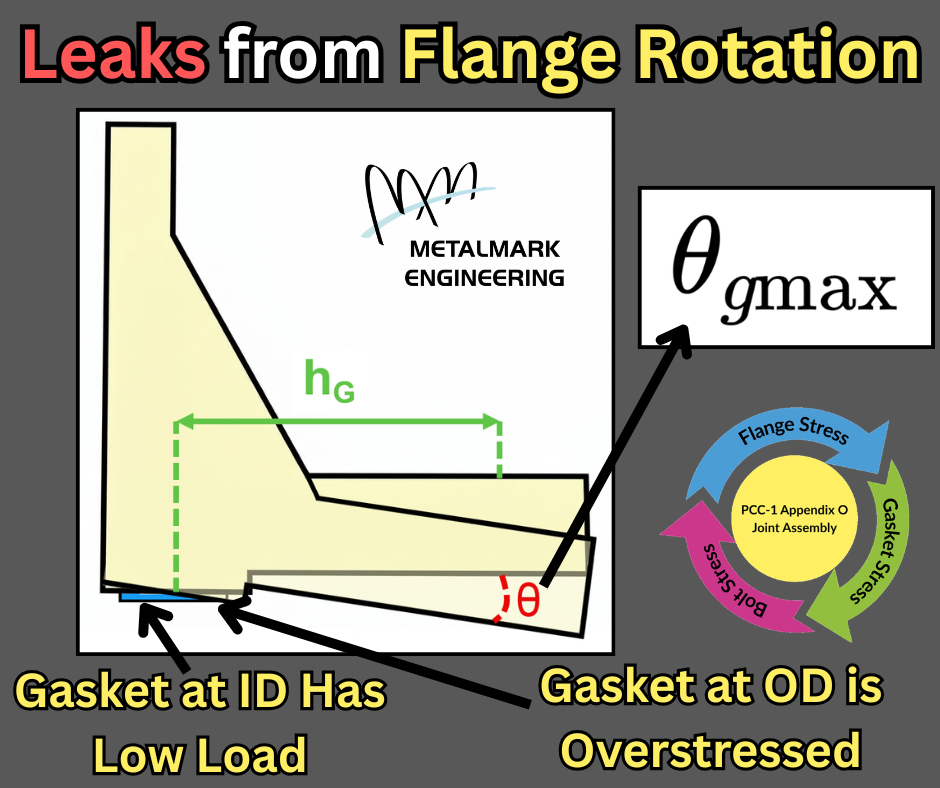
High Operational Flange Rotation Can Cause Leaks
What is operational flange rotation? Operational flange rotation occurs when bolt load plus thermal expansion through the flange and hub causes the flange to rotate at the Moment Arm, hG, at the operating temperature. Excessive rotation around the Moment Arm, hG, causes uneven gasket loading between the inner and outer gasket diameters. In extreme cases the gasket at the inner diameter may experience no load while the gasket at the outer diameter is crushed and destroyed.
A perfect recipe for a leaky bolted flange connection!
Leaks caused by operational flange rotation are often difficult to diagnose and even more difficult to remediate. This is because the first solution is usually tightening the bolts to a higher torque, which will make the problem worse.
Please pay attention to Maximum Permissible Flange Rotation, 𝛳gmax, and the Single Flange Rotation at Sfmax, 𝛳fmax, per ASME PCC-1 Appendix O for your bolted flange connections, especially for processes at elevated temperatures.