
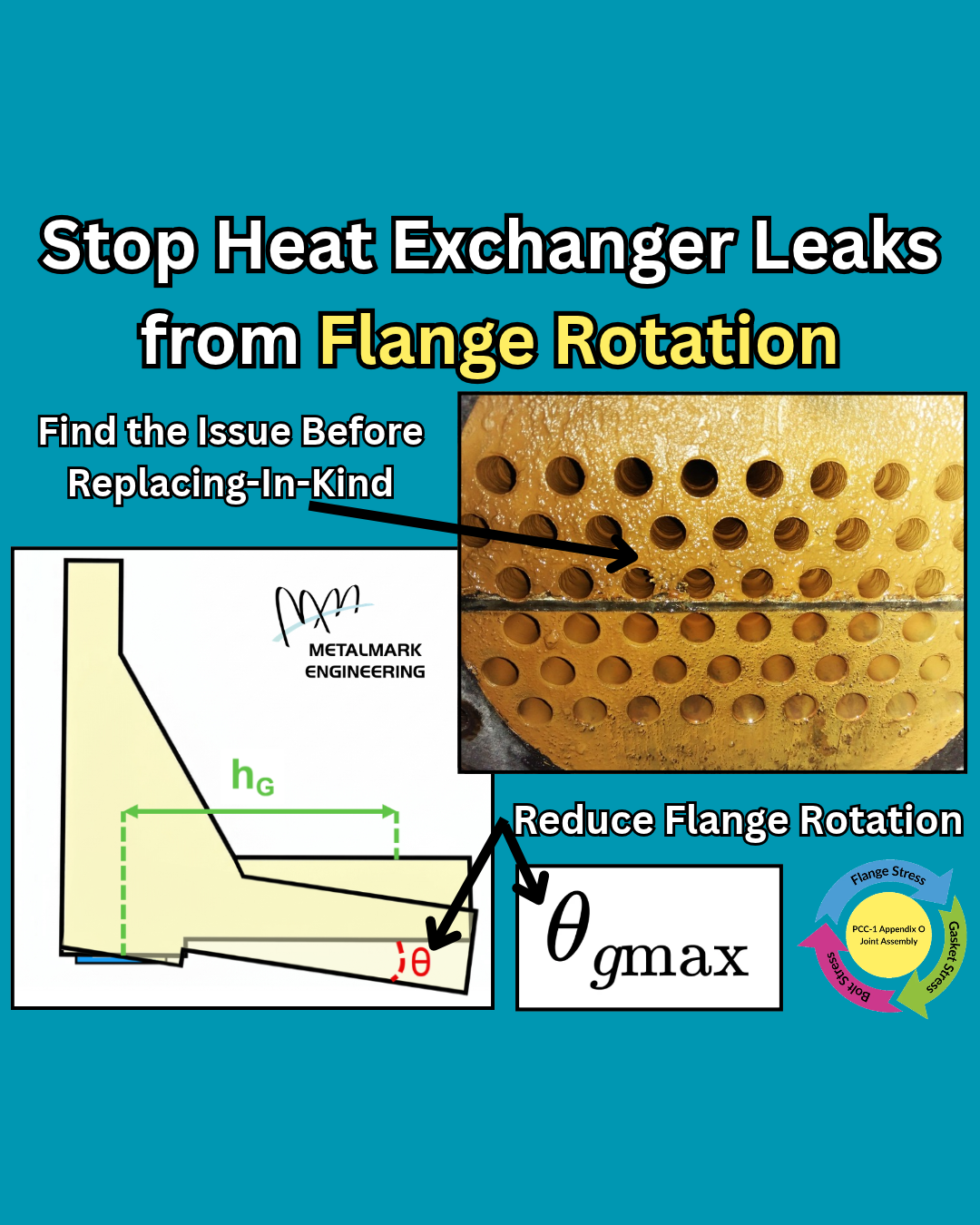
Heat Exchanger Leaks from Operational Flange Rotation
Having issues with your heat exchanger leaking at the tubesheet flanges? Flange rotation at the Moment Arm, hG, may be the root cause!
Replacing the tube bundle in-kind and using the same bolt torque values is the typical solution for solving heat exchanger leaks. However, a new tube bundle may not solve problems from flange rotation because the issue may be with the design. In fact, I’ve seen facilities replace the same tube bundles every 6 months for decades! A couple of simple checks can save a huge headache.
Please check these two cases to ensure that the flange rotation limit is not exceeded in your design:
Thermal expansion through the flange and hub. Flange rotation caused by thermal expansion is especially important in heat exchangers because leaks around the pass partitions become more likely when the rotation limit is exceeded.
Differential pressure across the tubesheet. Many times flange rotation caused by differential pressure loading cannot be rectified by simply updating the bolt torque values. I often propose a redesign instead of replacing-in-kind for these cases because increasing the tubesheet thickness greatly reduces the flange rotation.
I recommended checking if the flange rotation limit is exceeded for your heat exchanger design by calculating the Maximum Permissible Bolt Stress Prior to Flange Damage, Sfmax, using the correct Maximum Permissible Flange Rotation, 𝛳gmax, for your gasket type, and determining an appropriate Single Flange Rotation at Sfmax, 𝛳fmax, for your design per PCC-1 Appendix O.
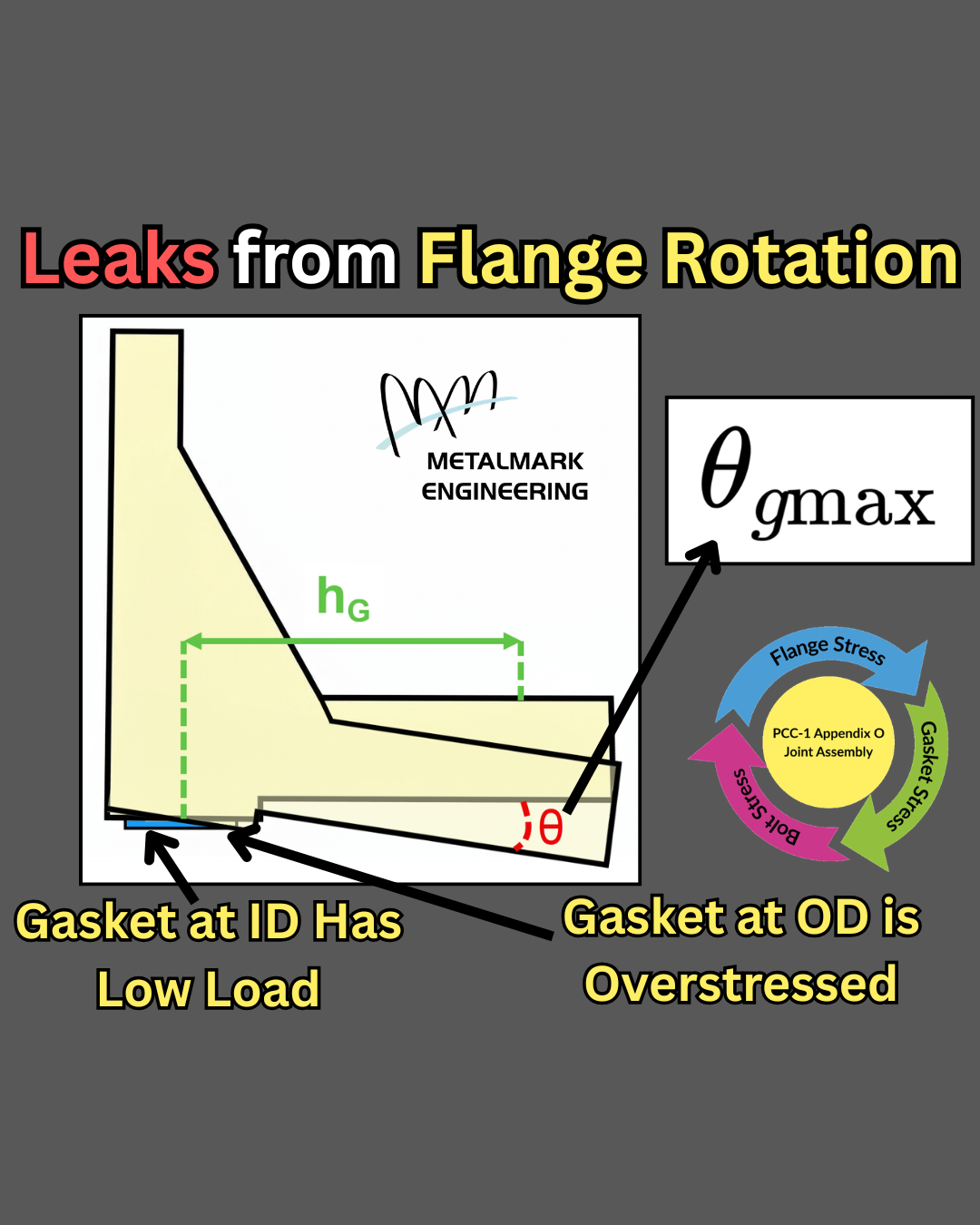
High Operational Flange Rotation Can Cause Leaks
What is operational flange rotation? Operational flange rotation occurs when bolt load plus thermal expansion through the flange and hub causes the flange to rotate at the Moment Arm, hG, at the operating temperature. Excessive rotation around the Moment Arm, hG, causes uneven gasket loading between the inner and outer gasket diameters. In extreme cases the gasket at the inner diameter may experience no load while the gasket at the outer diameter is crushed and destroyed.
A perfect recipe for a leaky bolted flange connection!
Leaks caused by operational flange rotation are often difficult to diagnose and even more difficult to remediate. This is because the first solution is usually tightening the bolts to a higher torque, which will make the problem worse.
Please pay attention to Maximum Permissible Flange Rotation, 𝛳gmax, and the Single Flange Rotation at Sfmax, 𝛳fmax, per ASME PCC-1 Appendix O for your bolted flange connections, especially for processes at elevated temperatures.

Hub Length Impacts Sfmax
Flange hub length has a big impact on the Maximum Permissible Bolt Stress Prior to Flange Damage, Sfmax. Make sure you get it right.
I’ve presented ASME PCC-1 Appendix O to facilities all across the United States. One not-so-obvious mistake I’ve found reviewing their torque tables pertains to the flange hub length. Let’s go over a couple of issues:
One facility assumed no flange hubs in the Sfmax calculation for their welding neck flanges. This ensures that the effect of Longitudinal Hub Stress, SH and Radial Flange Stress, SR cannot govern (because they are not calculated). This approach is not recommended as it does not represent reality and is unconservative.
Another facility assumed full length hubs for their ASME B16.5 flanges in the Sfmax calculation when shorter hubs were actually used in the plant. The shorter flange hubs still complied with ASME B16.5 but meant they could not rely on the standard torque tables they were using.
Is anyone reviewing the torque tables at your facility? Today is a great day to get your review started.