
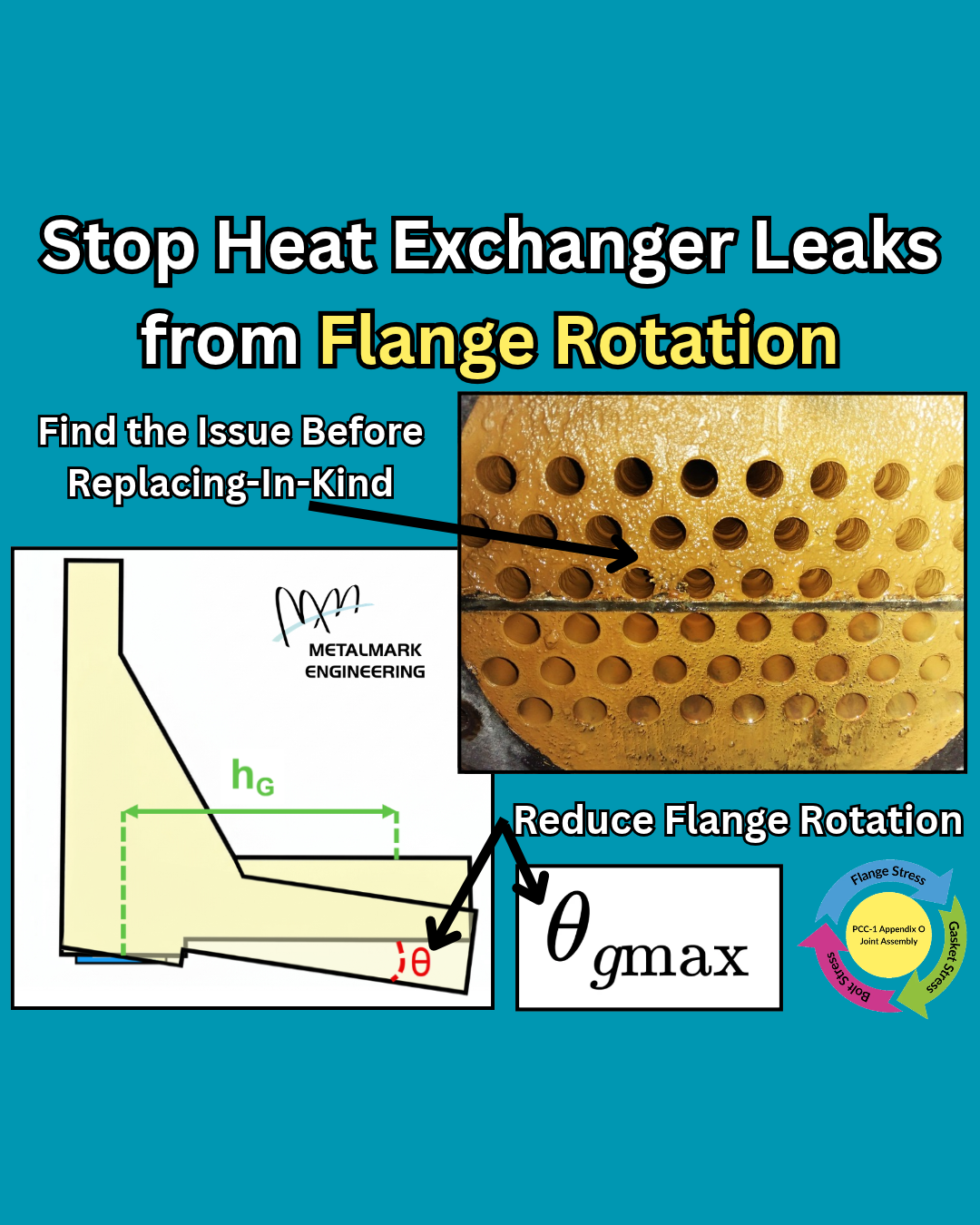
Heat Exchanger Leaks from Operational Flange Rotation
Having issues with your heat exchanger leaking at the tubesheet flanges? Flange rotation at the Moment Arm, hG, may be the root cause!
Replacing the tube bundle in-kind and using the same bolt torque values is the typical solution for solving heat exchanger leaks. However, a new tube bundle may not solve problems from flange rotation because the issue may be with the design. In fact, I’ve seen facilities replace the same tube bundles every 6 months for decades! A couple of simple checks can save a huge headache.
Please check these two cases to ensure that the flange rotation limit is not exceeded in your design:
Thermal expansion through the flange and hub. Flange rotation caused by thermal expansion is especially important in heat exchangers because leaks around the pass partitions become more likely when the rotation limit is exceeded.
Differential pressure across the tubesheet. Many times flange rotation caused by differential pressure loading cannot be rectified by simply updating the bolt torque values. I often propose a redesign instead of replacing-in-kind for these cases because increasing the tubesheet thickness greatly reduces the flange rotation.
I recommended checking if the flange rotation limit is exceeded for your heat exchanger design by calculating the Maximum Permissible Bolt Stress Prior to Flange Damage, Sfmax, using the correct Maximum Permissible Flange Rotation, 𝛳gmax, for your gasket type, and determining an appropriate Single Flange Rotation at Sfmax, 𝛳fmax, for your design per PCC-1 Appendix O.